



Deciding whether to award a performance bonus is more than a financial question.
It requires balancing results, expectations, and the message you want to send across the organization. When structured properly, performance bonuses reinforce the right behaviours, support accountability, and help retain high performers.
When the criteria are unclear or inconsistent, the impact can be the opposite and create frustration or a sense of unfairness.
As workplaces evolve and employee expectations shift, leaders need a clear and consistent approach to bonuses that aligns with business priorities, promotes fairness, and remains financially sustainable.
This guide explains how to determine if a bonus is appropriate, how much to award, and what criteria should guide the decision. It provides a practical framework that helps leaders make confident choices that benefit employees and the organization.
1. What Is a Performance Bonus?
A performance bonus is a financial reward given to an employee when their results exceed expectations or when they contribute meaningfully to the success of a team or project. Unlike base salary, which compensates for the role itself, a performance bonus recognizes outcomes, behaviours, and impact.
Companies typically use performance bonuses to strengthen accountability, reward strong contributions, and encourage employees to focus on the results that matter most to the organization. Depending on the structure, the bonus may be linked to individual performance, team outcomes, or overall company results.
Performance bonuses can take several forms: a fixed amount, a percentage of salary, a variable pay plan, or a non-cash reward such as additional paid time off or a professional development allowance. Whatever the format, the goal remains the same. A well-designed bonus reinforces the link between performance and reward and helps employees understand how their efforts support the organization’s priorities.
2. How to Decide Whether You Should Give a Performance Bonus
Not every strong effort requires a performance bonus, and not every positive outcome is a sign that a bonus is the right choice. Managers often face pressure to reward employees, yet the best decisions come from a balanced review of impact, expectations, and business context. Use the following factors to guide a consistent and fair decision-making process.
Evaluate Whether Results Truly Exceeded Expectations
A performance bonus should recognize contributions that go beyond what is required in the role. Ask yourself whether the employee delivered results that were significantly above target, took ownership of a complex challenge, or created meaningful value for the team or organization.
Confirm That the Contribution Can Be Measured
A bonus requires a clear basis. Review performance data, project outcomes, KPIs, client feedback, or documented achievements. The more precise the evidence, the easier it is to justify the decision and communicate it confidently.
Assess Whether the Behaviour Supports Long-Term Goals
Rewarding the wrong behaviours can create issues later. Consider whether the employee demonstrated collaboration, problem-solving, leadership, or other behaviours that reinforce team culture and organizational values. A strong outcome achieved in a way that creates conflict may not justify a bonus.
Check Budget and Financial Viability
Performance bonuses should never compromise team or organizational stability. Confirm that the department has the budget and that bonus decisions align with current financial priorities. If resources are limited, consider alternative recognition methods.
Ensure Consistency Across the Team
One of the quickest ways to create disengagement is to award bonuses inconsistently. Before making a decision, compare similar cases. Employees who deliver comparable results should receive comparable recognition. This reduces the risk of perceived unfairness and strengthens trust.
3. Types of Performance Bonuses
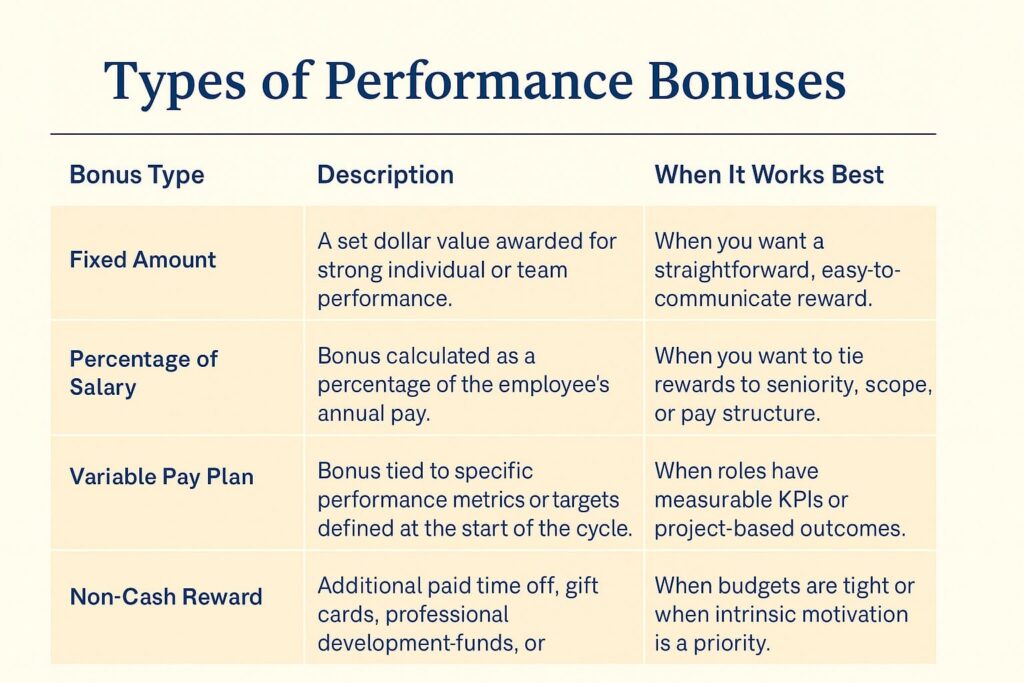
Performance bonuses can take several forms, and each type serves a different purpose. Understanding these options helps managers choose the most appropriate reward for the situation and communicate decisions with clarity.
Fixed Amount Bonus
A simple one-time payment awarded for strong individual or team performance. This format works well when you want a straightforward reward that is easy to explain and apply consistently.
Percentage of Salary
A bonus calculated as a percentage of the employee’s annual pay. This approach helps align rewards with seniority and role scope, and it offers a scalable way to recognize higher-impact work.
Variable Pay Plan
A structured bonus tied to specific performance metrics or targets. These plans are useful when employees have clear KPIs or when success can be measured through project milestones, productivity outcomes, or revenue generation.
Get a free assessment of your recruitment needs
Contact usNon-Cash Bonus
Recognition that does not involve direct monetary payment. This may include additional paid time off, a learning budget, a gift card, or other personalized rewards. Non-cash bonuses can be especially useful when budgets are limited or when the goal is to reinforce intrinsic motivation.
4. How Much Should You Give?
Determining the right bonus amount can be challenging. Managers want to reward strong performance fairly without creating unrealistic expectations or inconsistencies across the team.
A structured approach helps balance recognition, equity, and financial responsibility.
1) Start With a Clear Bonus Range
Most organizations define bonus ranges based on role level or salary bands. This creates consistency and ensures that similar contributions receive similar rewards. As a reference point, recent compensation data shows:
- Exempt employees often receive bonuses around 10 to 12 percent of base salary.
- Nonexempt salaried employees typically receive bonuses around 6 to 8 percent.
- Hourly employees may receive bonuses around 5 to 6 percent.
These benchmarks provide a starting point, not a rule. Your organization’s financial position and internal pay structure should guide final decisions.
2) Adjust Based on Impact and Achievement Level
Not all high performance is equal. Consider how much value the employee created, how challenging the goals were, and how their results influenced team or organizational outcomes. Many companies use a sliding scale. For example:
- Meeting expectations might result in a smaller bonus.
- Exceeding expectations may qualify for the full target bonus.
- Far surpassing expectations can justify a higher payout within the approved range.
This approach rewards true excellence while keeping bonuses tied to measurable impact.
3) Use a Transparent Formula When Possible
A simple formula can help managers communicate decisions clearly. For example:
Bonus amount = (Annual salary × Target bonus percentage) × Achievement level
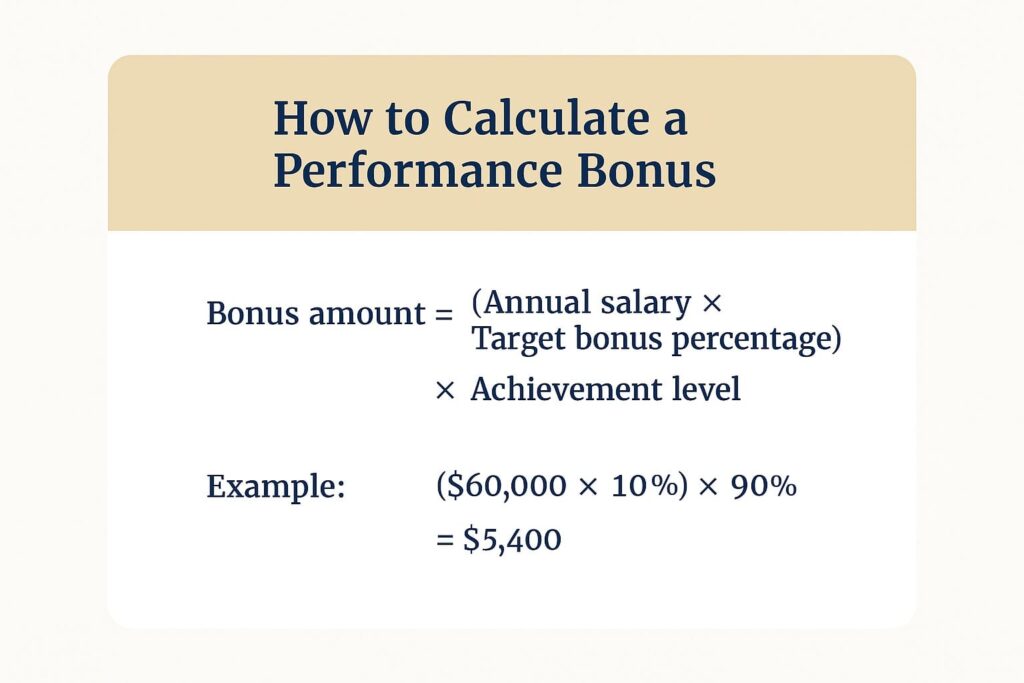
This structure ensures consistency and helps employees understand how their efforts translate into results.
4) Consider Non-Financial Factors
Budget constraints, departmental priorities, and broader economic conditions may influence bonus decisions. In some cases, a non-cash bonus or public recognition can complement or replace a financial reward. What matters most is that the rationale is transparent and the recognition feels meaningful.
5. What Criteria Should You Use to Award a Performance Bonus
Once you have determined that a performance bonus is appropriate, the next step is defining the criteria that justify the decision. Clear criteria help managers stay consistent, reduce bias, and make it easier to communicate decisions transparently. They also help employees understand what is expected and how their work is evaluated.
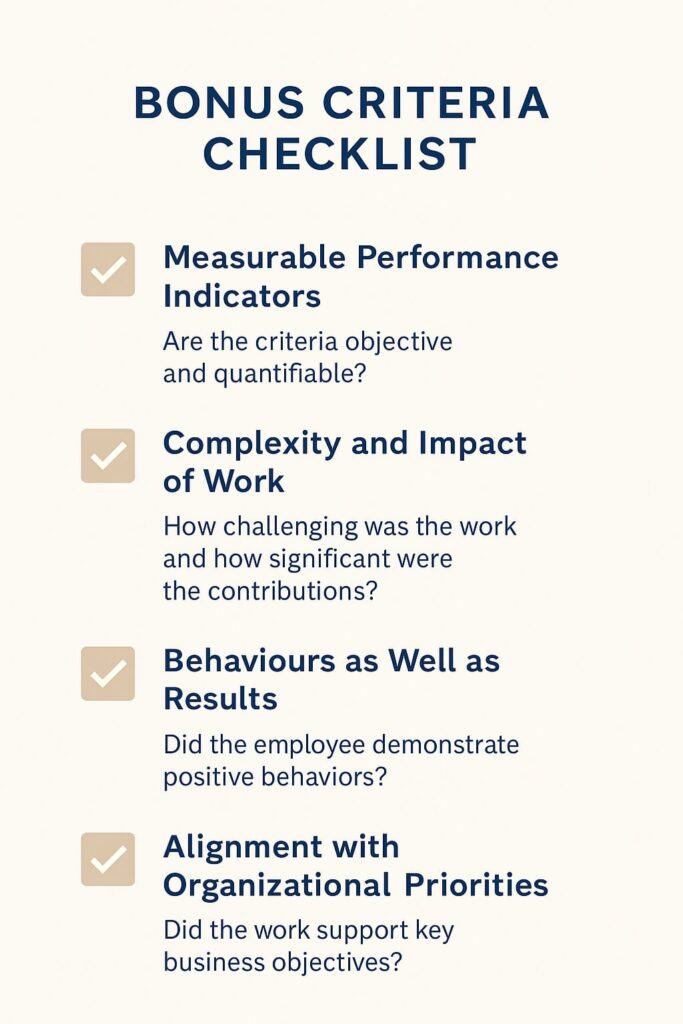
Use Measurable Performance Indicators
Start with the clearest evidence of performance. This may include productivity data, project completion timelines, quality metrics, customer satisfaction scores, or sales results. When the criteria are measurable, bonus decisions become easier to justify and defend.
Consider the Complexity and Impact of the Work
Strong results do not always require the same level of effort. Evaluate how much complexity the employee managed, how many obstacles they overcame, and how much their work contributed to broader team or organizational goals. High-impact contributions often warrant a higher or more meaningful bonus.
Review Behaviours as Well as Results
How employees achieve their results matters just as much as what they produce. Consider whether the employee demonstrated collaboration, professionalism, leadership, initiative, or strong communication. Rewarding positive behaviours reinforces the culture you want to build.
Check Alignment With Organizational Priorities
Bonuses should reinforce what the organization values. Ask whether the employee supported key business priorities, improved team performance, strengthened client relationships, or contributed to long-term growth. This keeps the bonus aligned with the strategy, not just the task.
Ensure the Decision Is Fair Across Comparable Roles
Fairness is essential. Before finalizing a bonus, compare the situation to similar roles and similar achievements. Employees doing comparable work should have access to comparable reward opportunities. This helps maintain trust and prevents perceptions of favouritism.
6. Advantages and Disadvantages of Performance Bonuses
Performance bonuses can be a powerful tool for recognizing contributions and strengthening engagement, but they also come with risks if they are not managed carefully. Managers should understand both sides before making or communicating a bonus decision.
Advantages
Stronger motivation and focus
Employees often feel more committed when they know their efforts can lead to meaningful recognition. Bonuses can encourage consistent performance and reinforce what the organization values.
Better alignment with business goals
A well-designed bonus program helps employees understand which outcomes matter most. When results are tied to clear goals, people are more likely to prioritize work that supports the organization’s strategy.
Support for retention efforts
Recognizing high performers helps strengthen loyalty and reduce turnover. Bonuses also show that the organization pays attention to individual contributions.
Financial flexibility
Because bonuses are not part of fixed compensation, organizations can adjust bonus budgets based on performance and financial conditions.
Disadvantages
Risk of perceived unfairness
If criteria are unclear or inconsistent, employees may question decisions. This can reduce trust and weaken engagement instead of strengthening it.
Short-term thinking
A bonus structure that focuses only on immediate results may encourage employees to prioritize quick wins over long-term value.
Increased pressure and potential burnout
The expectation of a bonus can create stress, especially in high-performance environments or when targets are aggressive.
Dependence on the reward
When employees begin to see bonuses as an entitlement rather than recognition, motivation can decline if bonuses are reduced or removed.
7. How to Communicate Performance Bonus Decisions
Even the most well-structured bonus program can lose impact if the reasoning behind decisions is unclear. How you communicate a bonus is just as important as the amount itself.
Clear and thoughtful communication helps employees understand why they received a bonus, how their work contributed to the organization, and what they can focus on moving forward.
Be Transparent About the Criteria
Employees should know which goals, behaviours, or achievements influenced the decision. Explain the key factors in simple, specific terms. This builds trust and reinforces the standards you expect across the team.
Focus on the Impact of the Work
Go beyond listing tasks. Describe how the employee’s contributions helped the team, the customer, or the business. Employees value recognition that feels personal, meaningful, and tied to outcomes.
Provide Guidance for Future Growth
Use the conversation to highlight what the employee can continue doing or strengthen. Bonus conversations are an opportunity to reinforce development, not only to reward past performance.
Be Consistent in How You Deliver the Message
Managers across the organization should communicate bonuses in a similar format and tone. Inconsistent communication can create confusion or unintended comparisons between team members.
Document Key Points
Record the rationale behind each bonus decision in your HR system or performance review tool. This helps maintain consistency year over year and supports fair decision-making as teams grow or change.
8. What HR Should Include in a Performance Bonus Policy
A strong performance bonus policy creates consistency, reduces bias, and ensures that employees understand how decisions are made. It also helps managers apply criteria fairly across teams. The goal is to build a policy that is clear, sustainable, and aligned with organizational priorities.
Define the Purpose of the Bonus Program
Start by explaining why the organization uses performance bonuses. Clarify how bonuses support your compensation philosophy, reward meaningful contributions, and reinforce strategic goals.
Explain Eligibility Requirements
Employees should know who has access to performance bonuses. Include details such as employment status, minimum tenure, job levels, or performance requirements. Clear eligibility rules prevent confusion and support fairness.
Describe the Evaluation Criteria
List the indicators used to assess performance. This may include KPIs, project outcomes, quality measures, behavioural expectations, or alignment with organizational values. The more specific the criteria, the easier it is for managers to make consistent decisions.
Detail the Bonus Structure
Outline how bonus amounts are calculated. Include information about target bonus percentages, bonus ranges, and how achievement levels influence payouts. If different departments or job levels use different structures, clarify these differences.
Clarify the Timing of Bonus Payments
Specify when bonuses are evaluated and paid. Many organizations align bonus cycles with performance reviews or fiscal year-end. Consistent timing helps manage expectations and supports budget planning.
Outline the Approval Process
Indicate who reviews and approves bonus recommendations. A clear approval structure helps maintain fairness, strengthens governance, and ensures decisions align with organizational guidelines.
Provide Guidance for Communication
Give managers direction on how to communicate bonus decisions. Encourage transparency, focus on impact, and emphasize recognition of effort and behaviour.
Ensure Documentation Requirements Are Clear
Explain how managers should record bonus decisions and the rationale behind them. Documentation helps HR track equity, identify trends, and refine the bonus program over time.
Conclusion
Performance bonuses can be a valuable tool when they are used with intention and supported by clear criteria. They help reinforce strong performance, strengthen engagement, and align employees with the organization’s priorities. The key is to approach every bonus decision with consistency, fairness, and a solid understanding of impact.
By evaluating results carefully, applying transparent criteria, and communicating decisions thoughtfully, managers can ensure that bonuses truly recognize meaningful contributions. A well-designed bonus program also helps employees understand what success looks like and how their work supports the broader goals of the organization.
When implemented with care, performance bonuses become more than a financial reward. They become a signal of appreciation, a driver of growth, and a practical way to support a high-performing culture.
Get a free assessment of your recruitment needs
Contact us