



The world of work is transforming at an unprecedented pace, and with it, the art and science of attracting top talent.
As we look toward 2026, the recruitment landscape is not just evolving; it’s undergoing a fundamental reinvention. Persistent talent shortages across key sectors, coupled with the rising expectations of a new generation of professionals, have rendered traditional hiring methods obsolete.
The old playbook of posting a job and waiting for applications is no longer sufficient. Winning in this new era demands a sophisticated approach that seamlessly blends cutting-edge technology with authentic human connection.
This guide outlines seven game-changing recruitment strategies designed to help you navigate this complex market, future-proof your talent acquisition function, and build a workforce capable of driving your organization forward.
The State of Recruitment in 2026
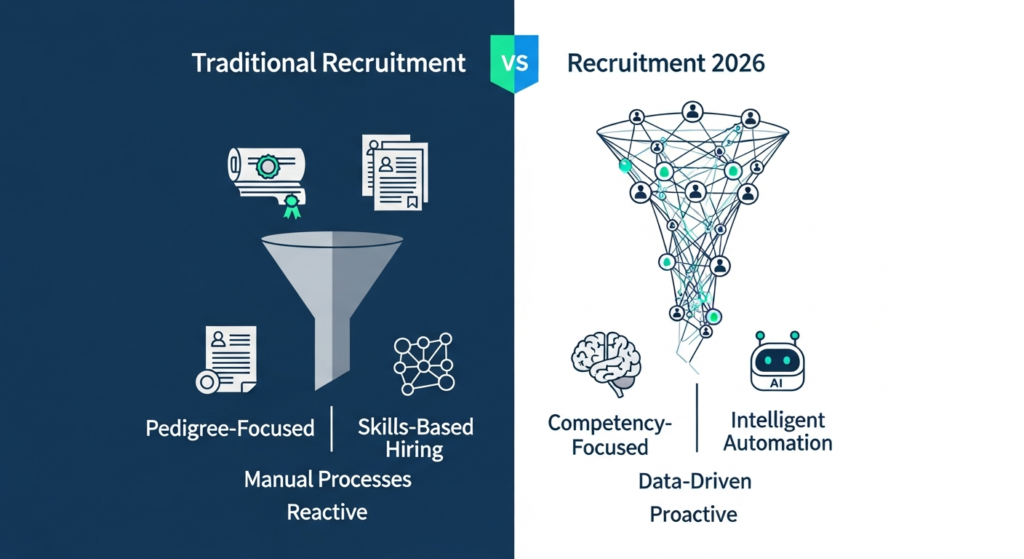
The evolution of recruitment: from a narrow, pedigree-based funnel to a wide, dynamic approach powered by skills and intelligent automation.
To understand where recruitment is going, we must first grasp where it stands today. The labour market of 2026 is defined by a paradox: while technology creates efficiencies, a profound scarcity of specialized human skills persists. Sectors like technology, healthcare, and specialized trades face chronic shortages, forcing companies to compete fiercely for a limited pool of qualified candidates. This competitive pressure has shifted power into the hands of talent, whose expectations for flexibility, purpose, and a seamless hiring process have never been higher.
In response, two powerful forces are reshaping modern talent acquisition: skills-based hiring and intelligent automation. Companies are increasingly looking past traditional credentials like degrees, focusing instead on verifiable competencies and practical abilities. This shift not only broadens the talent pool but also prioritizes genuine capability over pedigree.
Simultaneously, data and automation have become the backbone of efficient recruitment operations. From predictive analytics that forecast hiring needs to AI-powered tools that streamline sourcing, technology is empowering recruitment teams to make smarter, faster, and more informed decisions. The future of recruitment is not about replacing human insight but augmenting it with powerful analytical tools.
Key Recruitment Strategies for 2026
Strategy #1. Focus on Skills-Based Hiring
The most significant paradigm shift in modern recruitment is the move away from pedigree-based evaluation toward skills-based hiring. By 2026, focusing on what a candidate can do rather than where they studied will be a baseline requirement for competitive talent acquisition. This approach directly addresses skills shortages by widening the talent funnel to include candidates from non-traditional backgrounds who possess the necessary capabilities.
This strategy requires a tactical shift in the evaluation process. Instead of relying solely on resumes and degrees, organizations must integrate skill assessments, portfolio reviews, and practical work simulations. For technical roles, this might involve coding challenges; for creative roles, a review of past projects; for leadership positions, situational judgment tests.
This approach provides concrete evidence of a candidate’s ability to perform in the role, reducing the bias inherent in traditional screening methods. By prioritizing demonstrated skills, companies not only make a better hiring decision but also build a more diverse and capable workforce.
The first step is to work with department heads to map the critical competencies for each role and then build an assessment process designed to measure those specific skills.
Get a free assessment of your recruitment needs
Contact us
Strategy #2. Leverage AI for Smarter Sourcing
Artificial intelligence is no longer a futuristic concept in recruitment; it is a critical tool for efficiency and scale. The strategic use of AI in 2026 will focus on automating repetitive, high-volume tasks, thereby freeing up recruiters to concentrate on high-value, human-centric activities. AI-powered sourcing tools can scan millions of profiles across multiple platforms in minutes to identify passive candidates who match specific criteria, a task that would take a human recruiter days.
These tools can also automate initial outreach and screen incoming applications for key qualifications, ensuring a faster response time and a more consistent initial review. However, the most effective approach is a hybrid one. While AI excels at processing vast amounts of data, human oversight is essential to ensure fairness, mitigate algorithmic bias, and add a personal touch. The final decision must always rest with a human.
Recruiters should use AI as a powerful assistant that provides data-driven insights and handles logistical burdens, allowing them to invest their time in building authentic relationships, assessing cultural fit, and serving as strategic advisors to hiring managers.
This synergy between technological efficiency and human judgment is the winning formula for modern sourcing.
Strategy #3. Strengthen Employer Branding
In a transparent, hyper-connected market, your employer brand is your most valuable recruitment asset. It’s the narrative that explains why someone should join your organization over any other.
By 2026, maintaining an active, authentic employer brand will be a year-round strategic function, not a sporadic campaign launched only when you have critical roles to fill. A strong brand acts as a magnet for talent, attracting inbound applications from candidates who are already aligned with your mission and values.
Effective employer branding goes beyond a polished careers page. It involves consistently sharing genuine content that highlights your company culture, purpose, and the real experiences of your staff.
Encourage employees to share their stories on professional networks, create video testimonials, and offer a transparent look into a “day in the life” at your company. This content builds trust and community long before a candidate ever applies.
Companies with strong employer brands see a significant return on investment through reduced acquisition costs, as their reputation drives a powerful referral engine.
Activating your current staff as brand ambassadors is one of the most powerful tactics for building a compelling and believable employer reputation.
Strategy #4. Personalize the Candidate Experience
If employer branding is the promise, the candidate experience is the delivery of that promise. In a candidate-driven market, negative experiences can damage your brand and lead top talent to withdraw their applications.
By 2026, personalization and transparency will be the cornerstones of a successful candidate journey. This means moving beyond generic, automated communication and treating every applicant with respect.
The first step is to simplify the application process. Lengthy, cumbersome forms that take more than a few minutes to complete are a major deterrent. Aim for mobile-friendly applications that can be completed with minimal clicks. Throughout the process, maintain clear and consistent communication.
Take the time to acknowledge receipt of every application, provide realistic timelines for next steps, and inform candidates promptly when a decision has been made, even if it’s a rejection.
Offering transparency about the interview process, who they will be meeting, and what to expect helps reduce anxiety and sets candidates up for success.
Every interaction is an opportunity to reinforce your employer brand and leave a positive impression. A great experience can turn a rejected candidate into a future applicant or a source for referrals.
Strategy #5. Use Data-Driven Recruitment Marketing
The most effective talent acquisition teams in 2026 will operate like sophisticated marketing departments. A data-driven approach to recruitment marketing means moving beyond intuition and using analytics to optimize every aspect of your outreach. It involves tracking key performance indicators to understand which channels, messages, and tactics are delivering the highest return on investment.
Start by tracking the source of every application and, more importantly, the source of every hire. This will provide clear insights into which platforms, be it LinkedIn, industry-specific job boards, or social media campaigns, are yielding the most qualified candidates. Use this data to allocate your advertising budget more effectively.
Furthermore, implement retargeting tactics to stay engaged with qualified candidates who visited your careers page but didn’t apply. By showing them relevant content and job ads across other platforms, you keep your brand top-of-mind.
This strategic approach ensures that your recruitment budget is spent efficiently, your messaging is targeted effectively, and your decision-making is backed by measurable results.
Strategy #6. Prioritize Internal Mobility
Often, the most qualified candidate for an open role is already working within your organization. Prioritizing internal mobility is a powerful strategy that is faster, more cost-effective, and a significant driver of employee retention. When staff see clear opportunities for growth and advancement, they are far more likely to remain with the company long-term. An “internal-first” approach sends a powerful message that you invest in your people.
To make this a reality, organizations need to build a structured framework for internal movement. This includes creating well-defined career paths that show employees what skills and experiences are needed to advance. Implement mentorship programs to help junior staff learn from senior leaders. A key tool in this strategy is an internal talent marketplace, a platform where employees can view open roles, project opportunities, and mentorship connections.
This empowers staff to take control of their career development and enables managers to identify internal talent for their open positions. Before looking externally, create a seamless process for your own people to raise their hands for the next opportunity.
Strategy #7. Make DEIB a Central Priority
Diversity, Equity, Inclusion, and Belonging (DEIB) has rightfully moved from a peripheral HR initiative to a central business priority. Organizations that cultivate diverse teams are proven to be more innovative, adaptable, and profitable.
In 2026, embedding DEIB into every step of the recruitment process will be non-negotiable for attracting top talent, as candidates increasingly evaluate potential employers on their commitment to creating an inclusive workplace.
This requires a deliberate and measurable approach. Start by writing inclusive job descriptions that use neutral language and focus on essential skills to avoid inadvertently discouraging qualified candidates. Anonymize applications during the initial screening phase to reduce unconscious bias. Ensure interview panels are diverse to provide multiple perspectives in the evaluation process.
Beyond these tactics, it’s critical to track representation metrics across the entire recruitment funnel -> from application to hire -> to identify and address any drop-off points for underrepresented groups.
By integrating DEIB goals into recruitment KPIs and holding leaders accountable, you transform well-intentioned words into meaningful, systemic change.
Measuring Recruitment Success
The evolution of recruitment strategies requires a corresponding evolution in how we measure success.
While traditional metrics like time-to-hire and cost-per-hire remain relevant for measuring operational efficiency, the success indicators for 2026 must be far more strategic. They need to reflect the long-term business impact of hiring decisions.
The most critical metric is Quality of Hire. This is typically measured by assessing the performance reviews, productivity, and cultural fit of new employees after their first six to twelve months. A high quality-of-hire score indicates that the recruitment process is successfully identifying individuals who thrive and add significant value.
Another key indicator is the one-year retention rate of new hires. High turnover among new staff often signals a mismatch in expectations or a flaw in the selection process.
Furthermore, candidate satisfaction should be formally tracked, perhaps through a Net Promoter Score-style survey sent to all applicants. This provides direct feedback on the candidate experience. Finally, DEI representation metrics are essential success indicators. Tracking the diversity of your applicant pools, interview slates, and new hires provides a clear, quantitative measure of your progress toward building a more equitable and inclusive organization.
Conclusion
The recruitment landscape of 2026 is one of immense challenge and opportunity. The strategies that led to success in the past are no longer adequate for the complexities of the future. The new recruitment playbook is proactive, intelligent, and deeply human. It blends the analytical power of data, the efficiency of AI, and the irreplaceable value of authentic connection and empathy. The seven strategies outlined in this guide provide a comprehensive framework for building a modern talent acquisition function that is both resilient and competitive.
Companies that evolve early by embracing skills-based hiring, personalizing the candidate journey, leveraging data-driven insights, and championing internal talent will not only survive the war for talent; they will thrive. They will attract and retain the best people because their recruitment process itself is a testament to their values and their vision for the future.
We encourage you to reassess your current recruitment strategies and identify the first step you can take to leverage innovation. The future of your workforce depends on the decisions you make today.
Get a free assessment of your recruitment needs
Contact us