

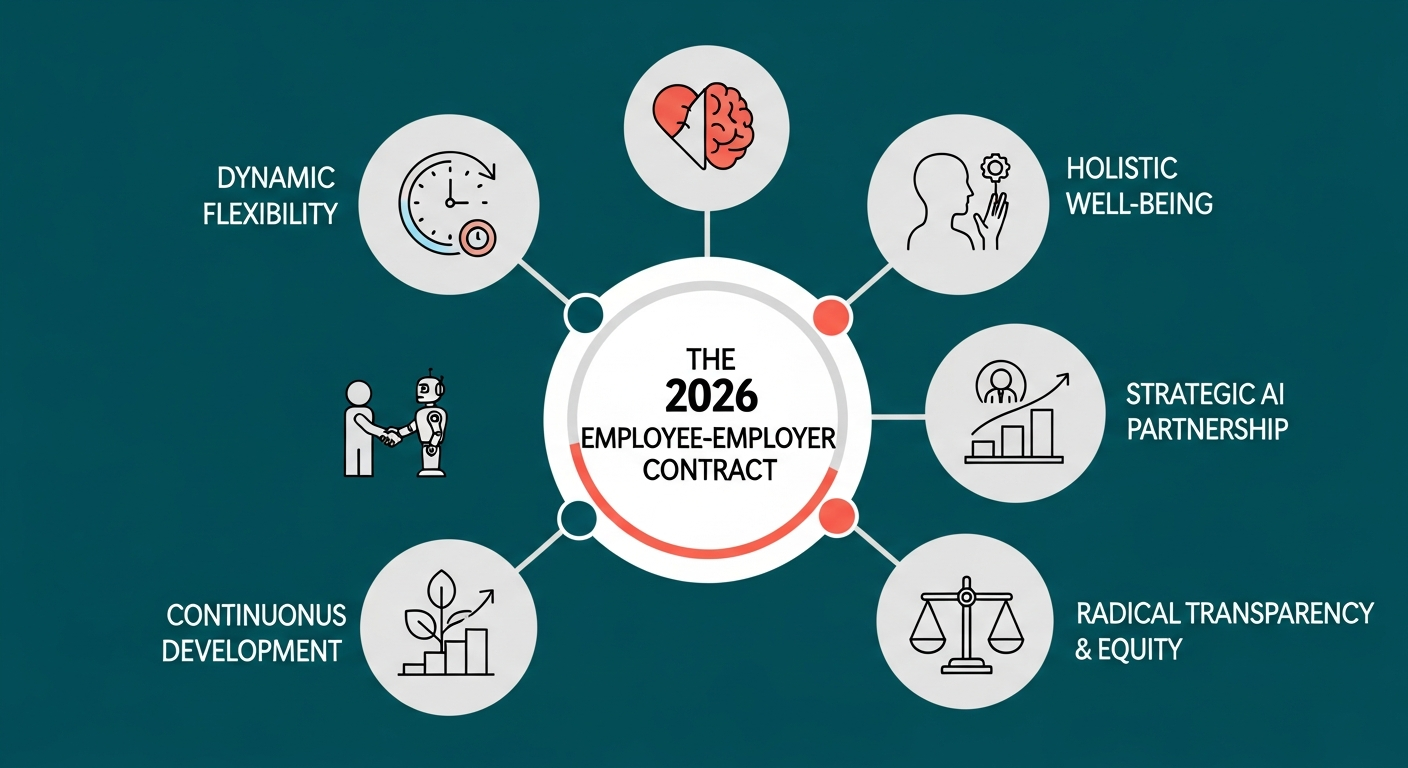

The labor market of 2026 is fast approaching, driven by shifting employee expectations. A new employer-employee contract is forming, redefining fulfilling work. Organizations that don’t adapt risk losing in recruitment and retaining top talent.
This article examines the key expectations employees will have in the workplace by 2026, focusing on essential areas like flexibility, well-being, strategic AI integration, ongoing development, and the core principles of transparency/equity.
Understanding these expectations isn’t just a choice; it’s crucial for building a resilient and prosperous workforce.
A New Era of Expectations
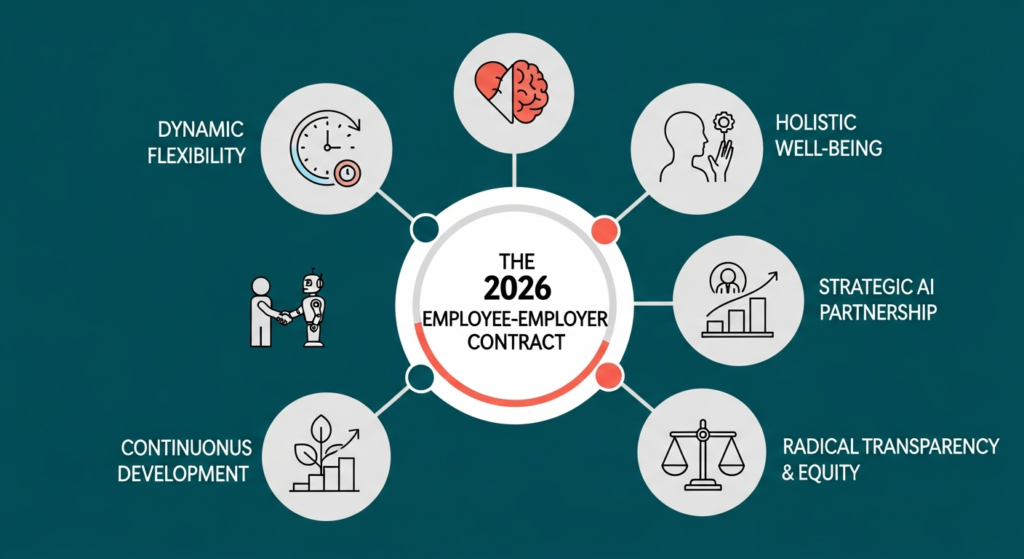
The new employee-employer contract is built on five core pillars of expectation for 2026.
The work scene in 2026 is being shaped by a mix of big changes. With fresh faces joining the workforce and seasoned pros rethinking their career paths, people are expecting a lot more from their jobs. This shift is taking us away from the old “just a paycheck” mindset to something that’s all about connection and putting people first.
Why Employee Expectations Are Redefining the Labour Market
Employees aren’t just voicing wishes – their expectations are like waves crashing into the labor market, changing everything. By 2026, companies that get with the program and focus on what employees really want are set to pull ahead of the pack.
But for those dragging their feet, good luck trying to reel in and keep the best talent around. The whole idea of being a company everyone wants to work for is getting a makeover.
Now, it’s all about giving people freedom, meaning, and a real partnership vibe. This game-changer is pushing businesses to rethink how they handle talent – from hiring day one to keeping folks engaged and motivated for the long haul.
The Demand for Dynamic Flexibility: Beyond Hybrid Work
The conversation around work location has moved far beyond a simple binary of remote versus in-office. Employees expect a far more nuanced and dynamic approach to flexibility, one that empowers autonomy and prioritizes outcomes over rigid structures.
This demand reflects a deeper understanding of how individuals can maximize their productivity while maintaining a healthy work-life balance.
Hybrid and Remote Work as the Non-Negotiable Standard
The widespread adoption of hybrid and remote work models during recent years has cemented them as a baseline expectation for a significant portion of the workforce. As we enter 2026, these arrangements will be less of a perk and more of a standard offering, particularly for roles that can be performed effectively outside a traditional office setting.
Data consistently shows that flexibility is a key driver for job seekers. For instance, studies indicate that in early 2024, a substantial 40% of US workers with advanced degrees teleworked, a figure significantly higher than those with less education.
This shows a widening gap where flexibility is more and more linked to skills and education, so it’s very important for employers looking to snag a mix of talent. If companies don’t get on board with solid remote or hybrid setups, they’ll be left in the dust when hiring, and might have to shell out more money to make up for the lack of flexibility.
True Workplace Flexibility Policies: Empowering Employee Autonomy
Real workplace flexibility isn’t just about picking where you work; it’s about giving your employees the freedom to set their own hours and figure out the best way to hit their goals. This means ditching the micromanaging and embracing a trust-filled approach that focuses on what gets done and how well it turns out.
Organizations that successfully implement dynamic flexibility will see enhanced employee engagement and productivity. This approach involves clear communication of expectations, measurable outcomes, and the provision of AI tools that facilitate seamless collaboration regardless of physical location.
Employers need to design policies that are adaptable, recognizing that individual needs and team requirements can vary, thereby fostering a culture of trust and accountability. This level of autonomy is a key component of a compelling employee value proposition (EVP).
Holistic Well-being and a Comprehensive Employee Value Proposition (EVP)
In 2026, employee well-being will be recognized not merely as a facet of benefits but as a core strategic pillar of the employee value proposition (EVP). Employees will expect employers to foster an environment that supports their physical, mental, and financial health, recognizing that a healthy workforce is a productive and engaged one.
Total Compensation Redefined: Beyond Base Salary
The definition of compensation is undergoing a significant expansion. While base salary remains crucial, employees in 2026 will look beyond this singular metric to assess their total reward package. This includes a robust array of benefits, opportunities for professional development, and a supportive work environment.
Organizations that view compensation holistically, encompassing health insurance, retirement plans, wellness programs, and learning stipends, will be better positioned to attract and retain talent. Furthermore, the demand for pay transparency is escalating, meaning employees expect clarity on how compensation decisions are made, including salary ranges and the factors influencing pay.
This comprehensive approach to the reward structure is fundamental to building a strong employee value proposition (EVP).
Cultivating a Culture of Well-being: Beyond Benefits Packages
Employee well-being in 2026 will be about creating a culture that actively promotes mental, physical, and emotional health. This goes far beyond the traditional scope of benefits packages. Statistics reveal the pervasive nature of mental health challenges; in fact, a significant 84% of employees faced at least one mental health challenge in the past year, including stress, burnout, or low motivation.
While a notable 74% of employees feel their company does enough to support their health and wellbeing at work, this still leaves a substantial segment feeling unsupported. Employers will be expected to offer proactive initiatives, resources for mental health support, and leadership training that emphasizes empathetic management.
Cultivating a genuine sense of care and support will be a key differentiator in attracting and retaining a healthy and engaged workforce.
True Work-Life Integration: Supporting Personal and Professional Harmony
The concept of work-life balance is evolving into work-life integration by 2026.
Employees desire workplaces where their professional and personal lives seamlessly blend. This requires employers to support diverse life situations, like family care or personal pursuits. Flexibility in work hours and deadlines is crucial, recognizing that productivity isn’t just about desk time.
Embracing AI as a Strategic Partner: The Human-AI Collaboration Imperative
The rapid advancement and adoption of Artificial Intelligence is set to fundamentally reshape the workplace by 2026. Employees will not just expect to work alongside AI; they will expect it to be a strategic partner that augments their capabilities, enhances productivity, and creates new opportunities.
AI-Enabled Work and Evolving Job Roles
By 2026, AI will be deeply embedded in many job functions, automating routine tasks and providing sophisticated analytical insights. This transformation means that job roles will inevitably evolve.
Employees will expect their employers to facilitate this transition by providing access to relevant AI tools and by redesigning roles to leverage human strengths in areas where AI is less adept, such as critical thinking, creativity, and emotional intelligence. The successful integration of automation and AI will not lead to mass displacement but rather to a shift in the skills required and the nature of work itself.
Employers need to proactively communicate the strategic vision for AI integration and support their teams through this evolution.
The Imperative for AI Skills and Continuous Upskilling
As AI becomes more prevalent, the demand for AI skills will soar. Employees understand that to remain relevant and competitive in the workforce, they need to develop new proficiencies. This fuels a strong expectation for employers to provide ample opportunities for upskilling and reskilling. Research consistently highlights this trend, with data showing that 74% of workers want to acquire new skills in their training to remain employed
Organizations that invest in continuous learning and development, particularly in areas related to AI and automation, will not only empower their employees but also build a more adaptable and future-ready organization. This commitment to growth is a critical component of a competitive employee value proposition (EVP). PwC’s AI Jobs Barometer underscores that AI skills now carry a premium, indicating a direct correlation between AI proficiency and enhanced earning potential.
Navigating AI Ethics, Governance, and Responsible Adoption
Beyond the technical aspects of AI adoption, employees will increasingly expect their employers to demonstrate a commitment to ethical AI practices. By 2026, concerns around data privacy, algorithmic bias, and the transparent use of AI in decision-making will be paramount.
Employees will seek assurance that AI tools are used responsibly, with clear governance frameworks in place to ensure fairness and accountability. This includes understanding how AI impacts performance evaluations, recruitment, and other critical HR processes. Employers that proactively address AI ethics and establish transparent guidelines will build trust and foster a more secure working environment for their workforce.
Skills-First Development and Continuous Career Growth
The usual stress on formal qualifications is gradually being replaced by a focus on tangible skills and continuous development. Employees are seeking growth opportunities that align with their abilities and career goals, establishing continuous learning as a fundamental expectation from employers.
Shifting from Credentials to Capabilities: The Skills-First Hiring Revolution
The recruitment landscape now see a significant shift towards a skills-first approach. Rather than solely relying on degrees or years of experience, employers will increasingly prioritize identifying and assessing an individual’s actual capabilities and potential for learning.
Career1 notes that in 2026, companies are moving away from ‘years of experience’ and focusing on skill proficiency and trainability instead. This methodology allows for a more diverse talent pool and ensures that hires possess the practical skills needed to excel in evolving roles, particularly those impacted by automation and AI adoption.
This focus on capabilities also drives performance by placing individuals in roles where they can best leverage their strengths.
Pathways for Continuous Learning and Upskilling
Employees now expect employers to provide clear and accessible pathways for continuous learning and upskilling. This goes beyond periodic training sessions to encompass ongoing development programs, mentorship opportunities, and access to resources that support skill acquisition. The desire to learn new skills is directly linked to job security and career progression, as evidenced by the 74% of workers wanting to acquire new skills to remain employed.
Clear Career Progression and Leadership Development
A clear vision for career progression is a fundamental expectation for employees in 2026. This means more than just occasional promotions; it involves a structured approach to internal mobility, skill development, and leadership training.
Employees want to understand the potential trajectory of their careers within an organization and feel supported in their journey. Organizations that offer robust leadership development programs not only cultivate future leaders from within but also signal a commitment to employee growth, enhancing their employer brand and overall talent attraction strategy. This focus on development is a key component of a compelling employee value proposition (EVP).
Transparency, Equity, and an Inclusive Culture as Foundational Pillars
In 2026, trust, fairness, and belonging will be non-negotiable elements of the employee experience. Employees will expect employers to operate with a high degree of transparency, ensure equitable treatment, and actively foster a diverse, equitable, and inclusive environment.
The Unwavering Expectation of Pay Transparency and Equity
Pay transparency is no longer a niche concern but a mainstream expectation for employees in 2026. This means not only disclosing salary ranges for open positions but also providing clarity on the factors that influence compensation decisions, such as performance, experience, and market rates. Employees expect to be treated equitably, with fair compensation practices that eliminate bias and ensure equal pay for equal work.
This commitment to transparency and equity is crucial for building trust and reducing the likelihood of employee dissatisfaction.
Fostering a Truly Diverse, Equitable, and Inclusive Environment
Establishing a truly diverse, equitable, and inclusive (DEI) environment has become imperative. Employees demand action over performative gestures, expecting companies to adopt real strategies that ensure belonging for everyone, regardless of background.
This involves tackling systemic biases in hiring, performance assessments, and pay structures. An inclusive culture mirrors the diverse makeup of today’s workforce and fuels creativity and better problem-solving by incorporating broader perspectives. Laying this groundwork is crucial for enhancing an employer’s reputation.
Building Trust Through Authentic Employer Branding and Values
An authentic employer brand is critical for attracting and retaining talent in 2026. Employees and potential candidates are increasingly scrutinizing organizations, looking for alignment between stated values and actual practices. Trust is built through consistent demonstration of integrity, fairness, and a genuine commitment to employee well-being and development.
When an organization’s values are lived and breathed through its policies, leadership, and day-to-day operations, it cultivates a strong sense of loyalty and positive perception.
The Evolving Role of Leadership and Management in 2026
Leadership and management styles must adapt to the new realities of work in 2026. The focus will shift from traditional oversight to a more supportive, coaching-oriented approach, particularly in the context of hybrid work environments and increasing AI adoption.
From Oversight to Coaching: The New Leadership Paradigm
By 2026, managers will be expected to transition from being overseers to becoming coaches and enablers. This paradigm shift is driven by the rise of flexible work arrangements and the need to foster autonomy and high performance. Leaders will need to focus on empowering their teams, providing constructive feedback, and supporting individual career development rather than simply monitoring tasks. This coaching approach is crucial for maintaining engagement and driving productivity in a distributed workforce.
Gallup’s findings that manager engagement fell to 27% in 2024 underscores the critical need for leadership development in this area.
Empathetic Management in a Hybrid and AI-Integrated World
Empathetic management will be a cornerstone of effective leadership in 2026, especially as organizations navigate the complexities of hybrid work and integrate AI tools. Managers will need to demonstrate a deep understanding of their team members’ individual needs, challenges, and aspirations. This involves actively listening, providing support for well-being, and facilitating effective collaboration across different work arrangements.
In an AI-integrated world, empathetic leaders will also guide their teams in leveraging AI tools ethically and effectively, ensuring that technology serves to enhance human capabilities rather than create anxiety or displacement.
Preparing for 2026 and beyond: Actionable Strategies for Employers
The expectations of employees in 2026 are clear, and organizations that proactively adapt will thrive. This requires a strategic approach to talent management, culture, and technology integration.
Auditing Your Current Employee Value Proposition
Begin by auditing your current employee value proposition (EVP). Evaluate compensation, benefits, flexibility, career development, and well-being to ensure they align with workforce expectations. Identify improvement areas to enhance your EVP and attract top talent. Also, assess pay transparency and whether your culture supports diversity, equity, and inclusion.
Investing in Future-Ready Talent and Technology
Investing in future-proof talent involves continuous learning, focusing on AI and automation skills. Companies must equip employees to adapt to changing roles by adopting AI tools that boost productivity and empowerment.
Additionally, support for remote and hybrid work through solid tech infrastructure is crucial. Success depends on investing in both people and technology.
Cultivating an Adaptive and Resilient Company Culture
Finally, employers must focus on cultivating an adaptive and resilient company culture. This involves fostering an environment of trust, psychological safety, and open communication, which are critical for navigating change and uncertainty. Encouraging collaboration, embracing new ideas, and demonstrating a genuine commitment to employee well-being will build a workforce that is not only capable of meeting future challenges but also motivated to do so. The high attrition rate in sectors like European tech, at 17.4% in the last 12 months, highlights the importance of a strong culture in retaining talent. Similarly, the global slip in engagement to 21% in 2024 emphasizes the need for leaders to foster environments where employees feel valued and connected.
Conclusion
Looking ahead to 2026 and beyond, what employees are looking for in their jobs is getting more complex and all-encompassing.
The workplace is becoming more centered around people, thanks to tech boosts like AI.
The businesses that will do well are those that roll with the punches, rethink what total compensation means by including overall well-being, and use AI as a team player, not just another gadget.
A killer employer brand will be built on clear pay, fairness, and really being inclusive.
Swapping micromanaging for thoughtful coaching in leadership, along with a focus on developing skills, will build up a workforce that’s both tough and enthusiastic.
By thoroughly evaluating their offerings, investing in future-ready talent and technology, and nurturing a flexible culture, employers will not only meet but exceed the expectations of 2026, creating a dynamic and thriving workplace.